🔭 3D Solar System Explorer
A full 3D Solar System Explorer!
Controls
Drag — Rotate the viewpoint (mouse and touch both supported)
Scroll — Zoom in and out
Click a planet — Focus on that planet and open its detail info panel
Bottom pill buttons — Jump directly to any planet instantly
Top toggles
Orbits — Show or hide the orbital ellipses
Labels — Planet name labels (also shown on mouse hover)
Asteroid Belt — 320 particles filling the asteroid belt between Mars and Jupiter
▶ Play / ⏸ Paused — Freeze or resume time
Bottom sliders
Time speed — Adjust orbital speed from 0× to 5×
Zoom — Zoom level from 0.3× to 4×
Per-planet details
☀️ Sun — Triple-layer corona glow with animated sunspot texture
🌍 Earth — Continent silhouettes with a Moon orbiting in real time
🪐 Saturn — Three-layer ring system with perspective shift as the viewing angle changes
🔴 Jupiter — Horizontal cloud bands with the Great Red Spot
All planets — Full 3D sphere shading with highlight and shadow passes
Focused planet — Orbital progress arc shown as a HUD overlay
Info panel — Click any planet to display its diameter, mass, distance from the Sun, day length, year length, moon count, temperature range, surface gravity, and a key fact.
👁 32
👍 0
Physics | Double Pendulum
🌌 Gravity Well — Hold the mouse button to spawn a second gravity source and watch particles shift their orbits. A real-time visualisation of Newton's Law of Universal Gravitation.
🔵 Double Pendulum — Two pendulums starting from nearly identical conditions trace completely different paths over time. An intuitive demonstration of the Butterfly Effect at the heart of chaos theory.
〰️ Wave Interference — Renders constructive and destructive interference patterns from two wave sources in real time. Drag either source to reposition it.
🪨 Sand Pile — Click and drag to pour sand and watch the Angle of Repose form naturally as grains settle into a self-organised slope.
✨ Lissajous Curve — Adjust the X/Y frequency ratio and phase to draw circles, figure-eights, pretzels, and more. The same principle behind oscilloscope waveform analysis.
🧲 Magnetic Field — Drag the N/S poles to new positions and watch the field lines instantly reform around them.
👁 62
👍 1

Interstellar Gargantua | 인터스텔라 가르강튀아
🌌 Tab 1 — Live Black Hole
A real-time interactive simulation of Gargantua. Hover over the canvas to see how much light bends at that point, with the deflection angle shown live.
Right-side control panel:
Spin (a) — Black hole rotation speed (Kerr parameter). Higher values make one side dramatically brighter due to relativistic beaming.
Disk brightness / thickness — Visual adjustments for the accretion disk appearance.
View angle — Shift the viewing perspective from face-on (90°) to edge-on (0°).
Hawking radiation — Visualises particle emission from the event horizon as a quantum effect.
📖 Tab 2 — Step by Step
Walks through the six stages that produce Gargantua's appearance, in order:
A massive star → 2. Core collapse (supernova) → 3. Schwarzschild radius → 4. Event horizon (sphere) → 5. Photon sphere → 6. Accretion disk + gravitational lensing
🔬 Tab 3 — Anatomy
Click any structural component to open a detailed explanation in the side panel; the corresponding layer highlights on the canvas simultaneously.
Components covered: Singularity · Event Horizon · Photon Sphere · ISCO (Innermost Stable Circular Orbit) · Accretion Disk · Ergosphere (spinning black holes only)
🌐 Tab 4 — Why a Sphere?
Answers the question "it looks like a ring, so why is it called a sphere?" from three angles:
Side view (the angle shown in the film) — explains why the back of the disk appears bent over the top through gravitational lensing
Top view (looking straight down) — shows the shadow is always circular regardless of orientation
3D sphere structure — compass arrows illustrate that the event horizon sits at the same radius in every direction
👁 15
👍 0
A seven-scene space shuttle mission explorer!
🚀 Launch — A full liftoff sequence with all three stages. The shuttle rides its 3 main engines and 2 SRBs off the pad, the SRBs separate at +2 minutes, and the External Tank drops at ~120km altitude. An altitude bar tracks the climb through the troposphere, stratosphere, mesosphere, and thermosphere with real smoke and exhaust particle effects.
🌍 Reaching Orbit — Shows why orbit is not "escaping" gravity but rather falling so fast that Earth curves away beneath you. Three trajectory paths illustrate the difference between too slow (falls back), just right (stable orbit at 7.8 km/s), and escape velocity (11.2 km/s). The orbiting shuttle has its live velocity and gravity vectors drawn in real time.
🌌 Hohmann Transfer — An animated solar system view with Earth and Mars in their orbits. The shuttle fires Burn #1 to enter the half-ellipse transfer orbit, coasts 259 days, then fires Burn #2 at Mars to circularise. The most fuel-efficient path between two planets — no engine during the 9-month coast.
🪐 Gravity Assist — A probe approaches Jupiter and curves around it, exiting faster than it entered — no fuel burned. The speed vector grows visibly as the probe swings around the gravity well. Used by Voyager, Cassini, and New Horizons to reach the outer solar system.
🔥 Re-entry — The shuttle descends through the atmosphere layers with real plasma heating effects. A temperature gauge shows the heat shield reaching 1,650°C. The entry corridor is narrow: too steep burns the shuttle up, too shallow and it bounces off the atmosphere.
🛬 Landing — Unpowered glide at a 22° angle (7× steeper than a 747) at 350 km/h. Landing gear deploys automatically on approach. The drag chute fires after touchdown. One shot, no go-around — if the approach is wrong, there is no second chance.
🗺️ Full Mission — All 10 phases of a complete Earth→Mars→Earth mission play out on a solar system map: Launch → Earth orbit → Burn 1 → 9-month transfer → Mars arrival → Mars operations → Return burn → 9-month return coast → Re-entry → Landing. To
👁 7
👍 1
🎉 A seven-concept fireworks explorer!
A seven-concept fireworks explorer!
🎆 Live Show — A full nighttime display over a city skyline with water reflections. Click anywhere in the sky to launch a firework. Shells leave glowing trails and burst into hundreds of particles. Auto-rate and gravity sliders let you adjust the show.
🚀 Launch Physics — Watch the projectile motion of a single shell. Real-time velocity and gravity vectors are drawn on the shell as it rises. A dashed trajectory prediction shows where it will go, and the burst point at peak altitude is marked. Includes the equations: y = v₀sinθ·t − ½gt².
💥 Burst Patterns — Six distinct shell types to explore: Peony (uniform sphere), Chrysanthemum (trailing stars), Ring/Kamuro (flat disc), Willow (long drooping tails), Spider (sharp radiating legs), and Palm (thick arcing arms). Click a type to switch; click the canvas to burst.
🎨 Color Chemistry — Click any element on the periodic table grid to see its flame color, the metal salt compound used, combustion temperature, and emitted wavelength. An animated electron orbital diagram explains why each element produces a unique color.
⚗️ Explosion Physics — Animates the three-phase lifecycle: shell rises on the lift charge → burst charge explodes with a visible shockwave → stars scatter and burn as they fall. A cross-section diagram shows the four internal layers of a shell. Includes the governing equations (PV=nRT, F=ma, E=hc/λ).
✨ Trail & Sparkle — Focuses on the individual burning "star" pellets. A timeline bar shows the ignition → peak brightness → fade → burnout progression. Sliders control burn time, star size, gravity, and air drag to show how each factor shapes the visual trail.
⏱️ Shell Timing — Shows how sequential electronic delay fuses create synchronized displays. A timing diagram plots each shell's launch and burst window. Click FIRE to launch the sequence and watch the shells go off one by one on their programmed schedule.
👁 32
👍 0
An eight-topic bacteria and virus explorer!
🦠 Bacteria Structure — The cell wall, cell membrane, nucleoid (DNA), ribosomes, plasmid, flagellum, pili, and cytoplasm are all labelled and animated. The flagella wave in real time, and hovering over any label highlights the corresponding structure.
🔴 Virus Structure — Switch between three virus types: naked capsid (adenovirus), enveloped (influenza / coronavirus), and bacteriophage (T4 phage — head + tail + leg structure). Each type shows its component parts and a list of real-world examples.
⚖️ Bacteria vs Virus — The two are placed side by side and compared across 10 categories: size, genetic material, cell wall, reproduction method, treatment, and more. Makes it immediately clear why antibiotics have no effect whatsoever on viruses.
💉 How Infection Works — A bacterial infection plays out automatically across 5 stages: entry → attachment → colonisation → immune response → resolution. Neutrophils (white blood cells) visibly chase and destroy bacteria in real time.
🔬 Binary Fission — Bacteria double every 20 minutes. The cell elongation, septum formation, and split into two daughter cells are all animated. An exponential growth graph is shown alongside.
🧬 Viral Replication — The lytic cycle unfolds across 6 steps: attachment → entry → uncoating → replication → assembly → lysis. In the final stage the host cell bursts, releasing hundreds of new viruses.
🛡️ Immune Response — Both innate immunity (neutrophils hunting and engulfing bacteria) and adaptive immunity (antibody production) are animated. Once all bacteria are eliminated, an "Infection cleared!" message appears.
📏 Size Comparison — A logarithmic scale runs from a human hair (70 µm) down to a single protein (5 nm). Illustrates the key fact that viruses are invisible even under a light microscope and can only be observed with an electron microscope.
👁 24
👍 1
˚.⋆🪐 ⋆⭒ Milky Way Galaxy ˚.⋆🪐 ⋆⭒
A seven-concept Milky Way explorer!
🔭 Top View — The spiral structure seen from directly above. All four major arms rotate slowly as density waves, just as they do in reality. A panel on the left shows diameter, thickness, star count, age, and galaxy type.
📏 Side View — The disk in cross-section, viewed edge-on. The thin disk (~1,000 ly), thick disk (~3,500 ly), and spherical halo (~200,000 ly) are rendered as distinct layers. Globular clusters (GCs) are scattered throughout the halo.
📍 Our Location — Watch the Solar System orbit slowly through the Orion–Cygnus Spur. Includes the actual orbital speed (~220 km/s), the length of a Galactic Year (~230 million years), and a list of the nearest stars to the Sun.
🌀 Spiral Arms — Click any of the four major arms — Perseus, Sagittarius, Scutum–Centaurus, and Norma — to highlight it in the galaxy view. Each panel shows the arm's key characteristics and distance from the galactic centre.
⚫ Galactic Centre — S-stars trace elliptical orbits around Sagittarius A* (Sgr A*). The relativistic jet, photon sphere, and event horizon are all shown, alongside details of the first-ever image captured by the Event Horizon Telescope in April 2022.
📐 Scale Comparison — A logarithmic scale bar runs from the Earth–Moon distance all the way to the Andromeda Galaxy. See intuitively just how small the Solar System is: if the Milky Way were shrunk to 10 km across, the entire Solar System would be smaller than a bacterium.
📈 Rotation Curve — The gap between the observed flat curve (gold) and the expected Keplerian decline (blue) is the evidence for dark matter. Use the Dark Matter slider to adjust the halo's contribution and watch the curve respond.
👁 39
👍 1
🪐 Solar System
A six-concept solar system explorer!
🌌 Solar System — All eight planets orbit the Sun at accurate relative speeds. Hover over any planet to see its rotation period, orbital period, axial tilt, and number of moons.
🔄 Rotation vs Revolution — The left panel shows rotation (one day) and the right shows revolution (one year), running simultaneously. See intuitively how Earth completes 365.25 rotations during a single trip around the Sun.
🌍 Earth & Moon — Visualises tidal locking — the phenomenon by which the Moon always shows the same face to Earth. This happens because the Moon's rotation period equals its orbital period: both are exactly 27.3 days. Watch the white marker on the Moon — it never stops facing Earth.
⚡ Orbital Speed — Following Kepler's 3rd Law (T² ∝ r³), inner planets orbit dramatically faster than outer ones. Arrow length represents relative speed — the difference between Mercury (47.9 km/s) and Neptune (5.4 km/s) is striking.
🌡️ Axial Tilt & Seasons — Drag the tilt slider from 0° (no seasons at all) to 98° (extreme) and watch the Northern Hemisphere sunlight percentage update in real time. Experience first-hand that seasons are caused by axial tilt — not by distance from the Sun.
📊 Planet Compare — Select any two planets to compare their rotation period, orbital period, axial tilt, and moon count side by side. You can verify for yourself that Venus's day (243 days) is actually longer than its year (225 days).
👁 54
👍 1
Atom & Electron Explorer
🪐 Bohr Model — Select any element from H, He, Li, C, O, Ne, Na, or Ar to watch its electron orbits drawn in real time. Click the nucleus to trigger a photon burst. An energy level diagram is shown on the right.
☁️ Electron Cloud — Choose from 1s (sphere), 2s (sphere with a radial node), 2p (dumbbell), or 3d (cloverleaf) to see the probability cloud rotate in 3D. Visualises how quantum electrons exist as a probability distribution, not a fixed orbit.
🌈 Emission Spectrum — Select Hydrogen, Helium, or Sodium, then press Excite Electron to watch an electron jump between shells and emit a photon of a specific colour. The real spectral lines for that element are displayed below.
📋 Electron Config — Raise the atomic number Z from 1 to 36 with the slider and watch electrons fill in Aufbau order (1s → 2s → 2p → 3s…) step by step. Includes explanations of Hund's Rule and the Pauli Exclusion Principle.
💥 Nuclear Structure — Adjust the number of protons and neutrons to watch the nucleons vibrate under the strong nuclear force. If the N/Z ratio falls outside the stable range, the nucleus is flagged as unstable. Binding energy in MeV is calculated live.
⚡ Photoelectric Effect — Push the frequency above the 4.5 eV threshold and electrons are ejected. No matter how high you set the intensity, electrons will not be emitted if the frequency is too low — experience first-hand the phenomenon that earned Einstein the Nobel Prize in 1921.
👁 16
👍 1
👽 SETI | Astrobiology
🔭 Drake Equation — Adjust all seven sliders to tune each term and watch the number of civilisations N update in real time. Optimistic settings produce thousands; pessimistic ones drop below one.
🤫 Fermi Paradox — A live simulation of 50 civilisations broadcasting signals outward. Most go extinct before their waves ever overlap. Experience first-hand why "the universe is so vast — yet so silent."
🌍 Habitable Zone — Change the star's mass to shift the Goldilocks Zone. Dial down from a Sun-like G-type to a red dwarf M-type and watch the habitable band shrink to an extremely narrow ring.
⚡ Kardashev Scale — Slide between levels 0 and 3 to explore Type I (planetary), Type II (Dyson Sphere), and Type III (galactic) civilisations — their energy scales and defining characteristics. Humanity currently sits at roughly Type 0.73.
☄️ Panspermia — Microbe-laden asteroids (green) travel between Mars, Earth, Europa, and Enceladus, seeding life on impact. Each successful delivery triggers a burst particle effect.
📡 First Contact — Set the distance and signal strength, then press SEND SIGNAL to watch your transmission travel at the speed of light. At 500 light-years, the round trip takes 1,000 years — and you feel every second of it.
👁 22
👍 1
Theory of relativity
🛗 Equivalence Principle — Switch between the Rocket, Both, and Gravity views to see that the physics inside an accelerating rocket and on Earth's surface are completely identical. This single insight was Einstein's starting point for General Relativity.
⚡ E = mc² — Set the mass with the slider, then press CONVERT to see the energy released and its TNT equivalent. A visceral demonstration of just how much energy is locked inside even a small amount of matter.
🌐 Curved Spacetime — Drag the sun to a new position and watch the spacetime grid warp in real time around it. The greater the mass, the deeper the curvature — and the faster the planets orbit.
🕰 Gravitational Time — The high-altitude clock (green) and the low-altitude clock (red) tick at different rates. The panel also shows the real-world figure: GPS satellites must correct for a drift of ~38 μs every day.
📏 Length Contraction — Push the speed slider up and watch the rocket shrink along its direction of travel. At v = 0.99c, γ ≈ 7 and the rocket is one-seventh its
rest length. The formula L = L₀ / γ updates live.
🕳 Black Hole — The Schwarzschild radius, event horizon, photon sphere, accretion disk, and relativistic jets are all rendered as a live animation, with key real-world figures shown in the panel.
👁 39
👍 1
4D | Spacetime Diagram
📐 Spacetime Diagram — A Minkowski diagram showing that time is the 4th dimension. Watch Alice (stationary) and Bob (moving at 0.5c) accumulate proper time τ at different rates in real time.
🔦 Light Cone — Drag the orange event point around the canvas. Hover anywhere to instantly classify that position as Future, Past, or Elsewhere. Nothing outside the cone can ever be reached without exceeding the speed of light.
⌚ Time Dilation — Push Bob's rocket speed up with the slider and watch the two clocks drift apart. The Lorentz factor γ updates live — and a reminder that GPS satellites correct for exactly this effect every single day.
🌀 Wormhole — Particles enter Mouth A in 2024 and exit Mouth B in 1924. A real-time visualisation of the Einstein–Rosen bridge and how curved spacetime can connect two different moments in time.
👴 Grandfather Paradox — What happens if you travel back and stop your grandfather? Click either choice and follow the logic to its conclusion — an infinite paradox loop versus the Novikov Self-Consistency Principle.
🌌 Many-Worlds — Every quantum decision splits the universe into parallel branches. Adjust the Split frequency slider to control how fast new timelines fork off, and watch the branching multiverse grow.
👁 25
👍 1
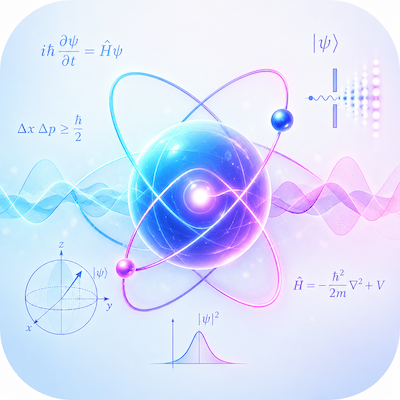
Quantum | Double-Slit Experiment
〰 Double-Slit — Slide the Observe control from 0 to 1 and watch the interference pattern vanish, replaced by a classical particle distribution. See for yourself how the act of measurement changes the outcome.
⟨ψ⟩ Superposition — The rotating arrow on the Bloch sphere represents the superposed state. Click it to collapse the wave function — the qubit will randomly resolve to either |0⟩ or |1⟩ according to its probability amplitudes.
Δ Uncertainty Principle — Narrow the position spread Δx with the slider and the momentum spread Δp widens in response. The product Δx·Δp ≥ ħ/2 is enforced at all times, shown live.
🚧 Quantum Tunnelling — Even when a particle's energy E is lower than the barrier height V, some particles pass straight through. The theoretical tunnel probability and the observed pass rate are displayed side by side.
🔗 Entanglement — Set different measurement angles for Alice and Bob, then click to measure both particles simultaneously. The quantum correlation between their outcomes is visualised in real time as the angle difference changes.
👁 26
👍 1
Periodic Table of Elements
The periodic table, also known as the periodic table of the elements, is an ordered arrangement of the chemical elements into rows ("periods") and columns ("groups").
https://en.wikipedia.org/wiki/Periodic_table
👁 27
👍 3
⚗️ 원소 주기율표
주기율표(週期律表, 영어: periodic table) 또는 원소 주기율표는 화학 원소를 가로줄("주기")과 세로줄("족")로 정렬한 표이다.[1] 화학의 상징이자 물리학 및 기타 과학 분야에서도 널리 사용된다.
https://ko.wikipedia.org/wiki/주기율표
👁 22
👍 1